Roger J. Wendell
Defending 3.8 Billion Years of Organic EvolutionSM

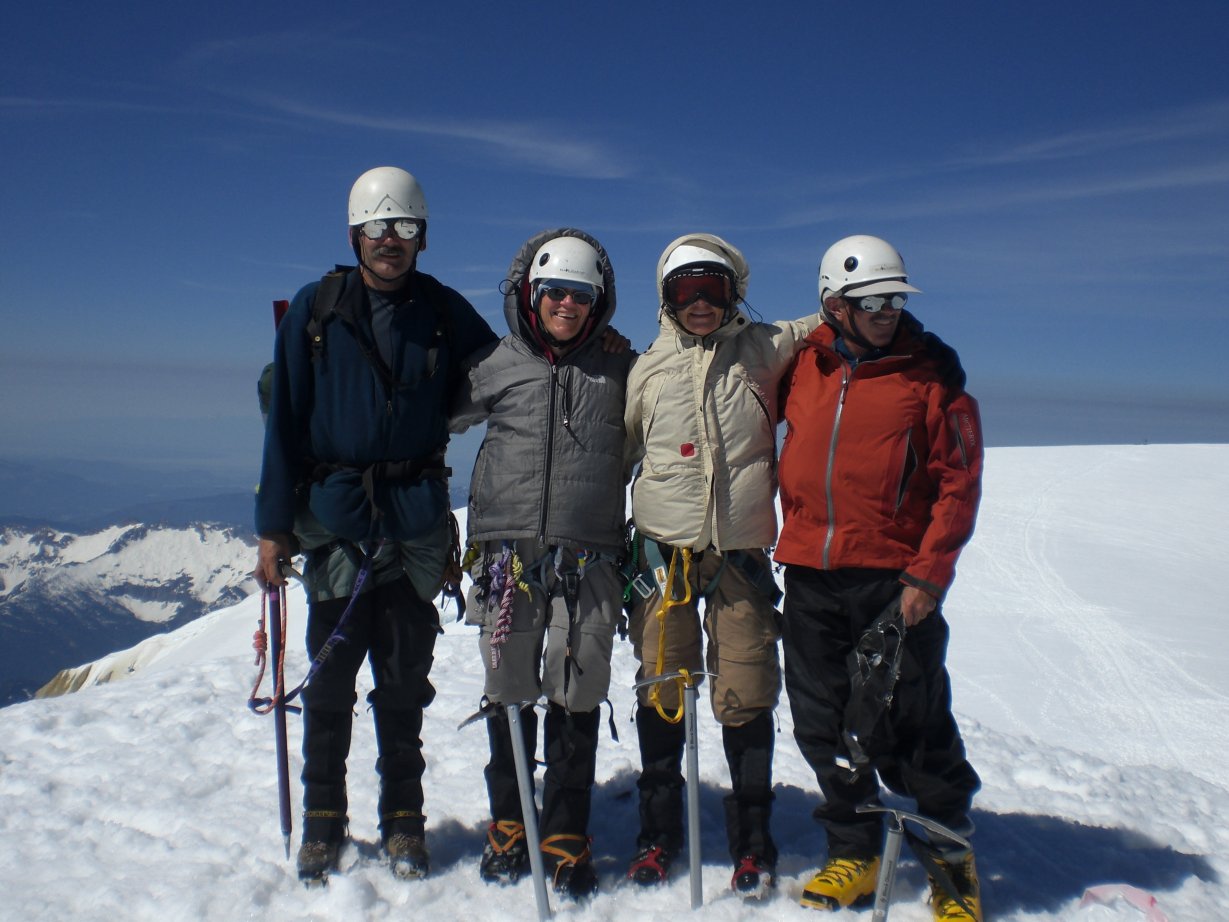
Left to Right: Me, Linda Jagger, Amy Hastings, and Tom Jagger on top of Mount Baker (Komo Kulshan) 10,778 ft - 06-29-2008This page is going to be a long work-in-progress as I didn't think of creating until I was 67-years-old in July, 2023. My guess is that I had hiked and climbed about 500 different peaks and summits before then! (not counting my 1,200 ascents of Mount Morrison by that age and dozens of other mountains that I repeated many times as well...)
I started creating climbing pages with the 14ers in my early 50s. I then started adding the 13ers, and higppoints pages in my early 60s, with 12ers a little after that. Prior to all of that I had completed countless 5ers, 6ers, 7ers, etc. that I had summited throughout my life but never recorded.
I climbed all of those lesser peaks as a boy in California, while on military duty in Hawai'i, and as a young man, adult, and then elder in Colorado. I suspect I'll never come close to piecing it all together but will try and record those I can remember or reference from other sources as time permits...
NOTE: LIDAR (Light Detection and Ranging) was put into use many decades after I started hiking and climbing. LIDAR is a more accurate way of measuring the Earth's surface and, as such, has changed what was believed to be the elevation of many mountains and highpoints. As a result, the "prominence" (at least 300 feet above a connecting saddle) of many mountains has changed along with their elevations. A personal example, for me, is Republican Mountain - a previously "unranked" 12er near Silver Plume that I climbed in 2022 after learning that LIDAR had determined it now had 312 feet of prominence. Peak 8, near Breckenridge is another personal example of change brought on by LIDAR. When I originally climbed Peak 8 I believed it to be a 12er, only to learn later that it's actual elevation is 13,005 feet! So, in summary, many of the elevations you see on my pages may not (yet) be accurate - requiring an update someday in the future as time permits!

|
Click Here for my 14ers page... |
|
|
Click Here for my 13ers page... |
|
|
Click Here for my 12ers page... |

|
Click Here for the Ten Essentials - Don't leave home without 'em! |
|
|
Click Here for my page on highpoints... |
|
|
Click Here for my general notes Climbing and Mountaineering. |
My List of Peaks Below 12,000 feet/3,657.6 metres:
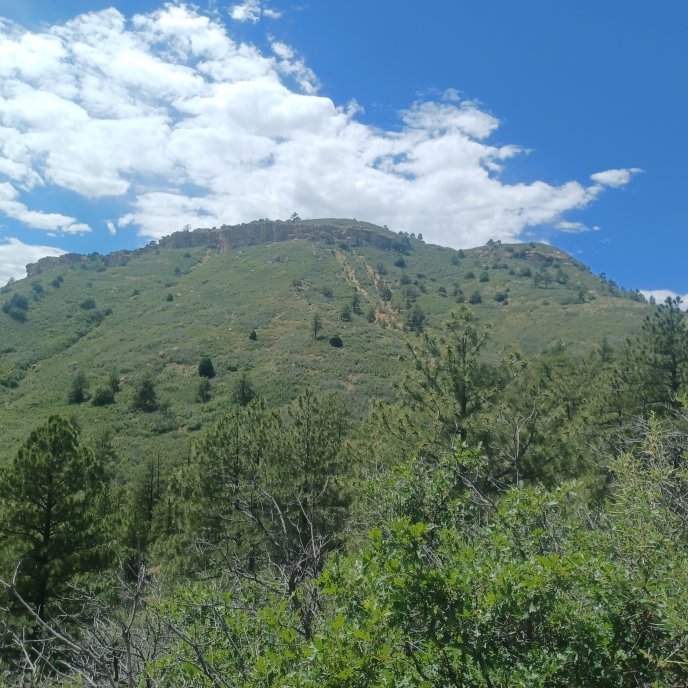
7,886 feet, 813 feet of prominence - Colorado's 3,746th highest peakAs of 22 June, 2026 I had completed 1,500 climbs to the top of Mount Morrison. (and back down again)
A note about "POTA" and "SOTA" At age 70, in 2025, I reduced the hours at my regular job down to just one day per week, becoming "mostly" retired. That gave me more time to pursue my love of Morse code, hiking and mountaineering. As such, I was able to combine these pursuits by operating QRP amateur radio in parks and on summits. So, anytime you see the acronyms "SOTA" (Summits on the Air) or "POTA" (Parks on the Air) next to a peak or place name it means I successfully "activated" that location using amateur radio.
For SOTA, as luck would have it, in late 2025 I was the first person to activate Colorado's Unnamed 10055 (W0C/SP-105), Floyd Benchmark (W0C/PR-150), and JCMD 93 Benchmark (W0C/FR-200) - I'm looking forward to many more!
11ers
10ers
9ers
8ers
7ers
6ers
5ers
4ers
3ers
2ers
1ers
0ers
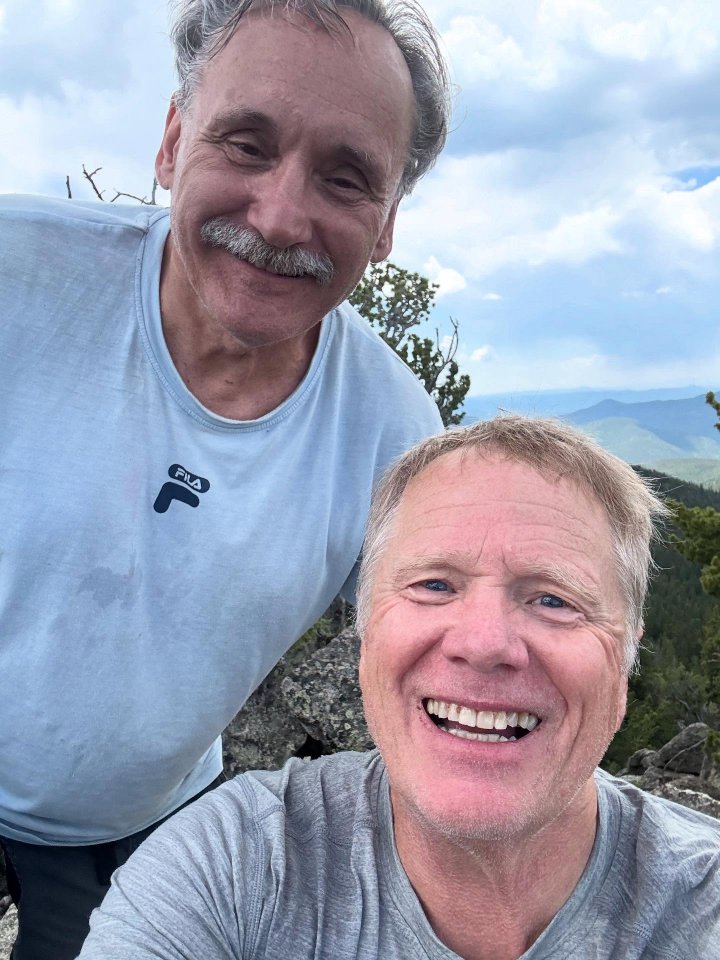
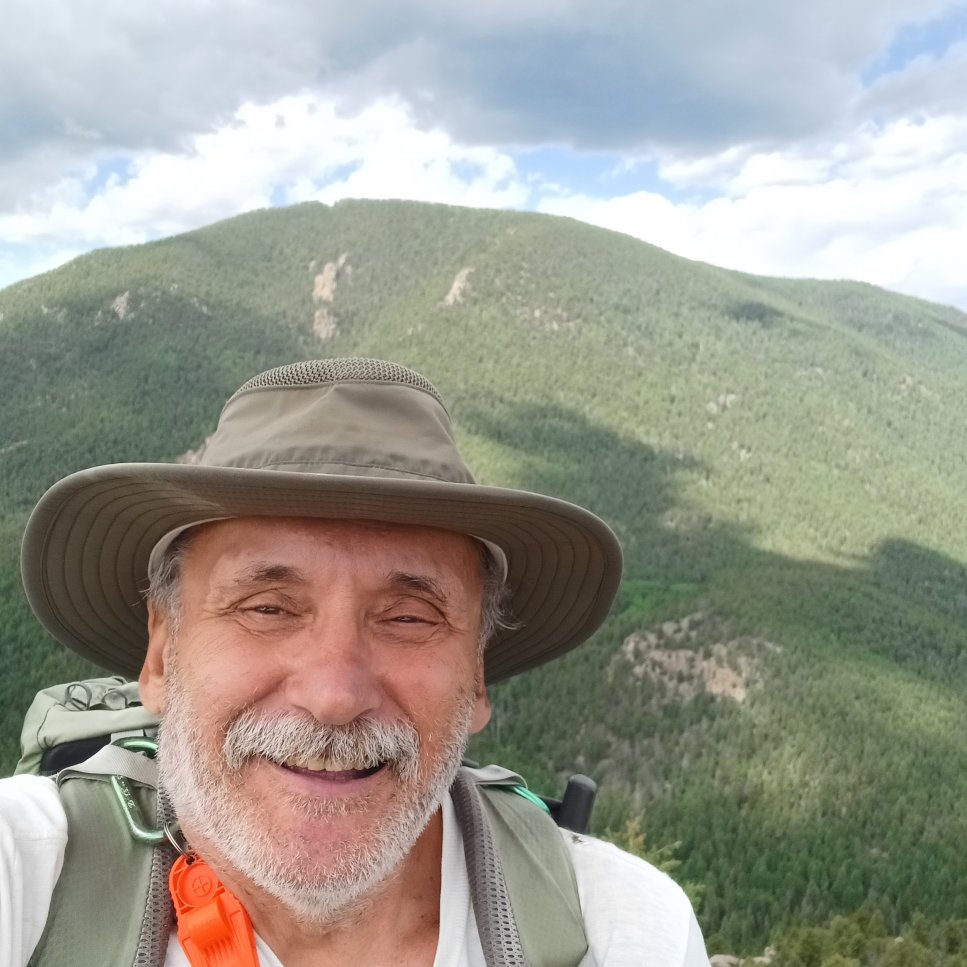
 Me on top of Bergen Peak (2,960 metres) after a spring snowstorm |
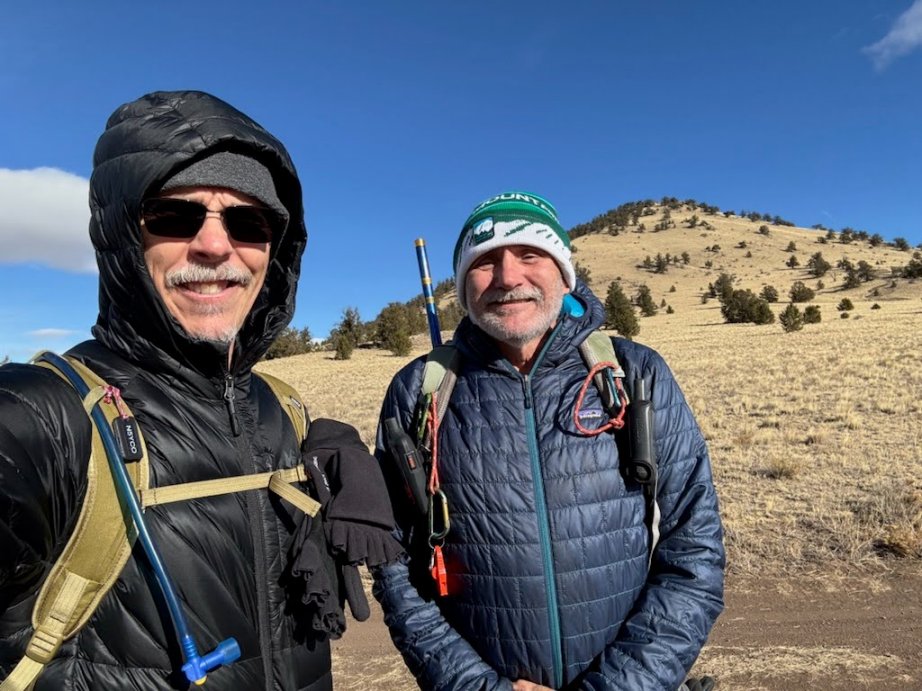
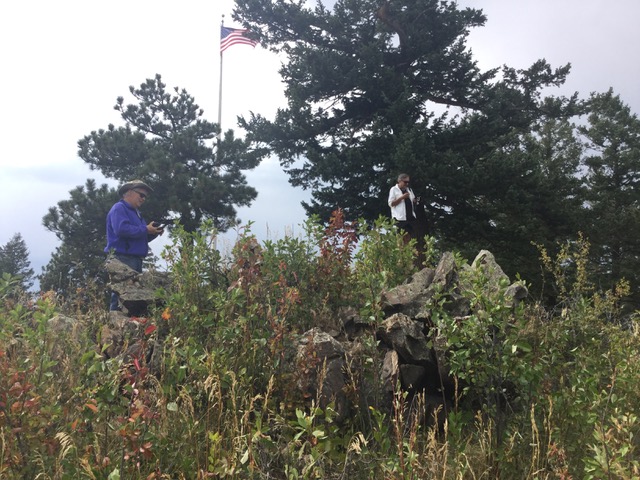
 Storm Peak (9,201 ft), Front Range, Colorado - Phil, Randy, and Roger |
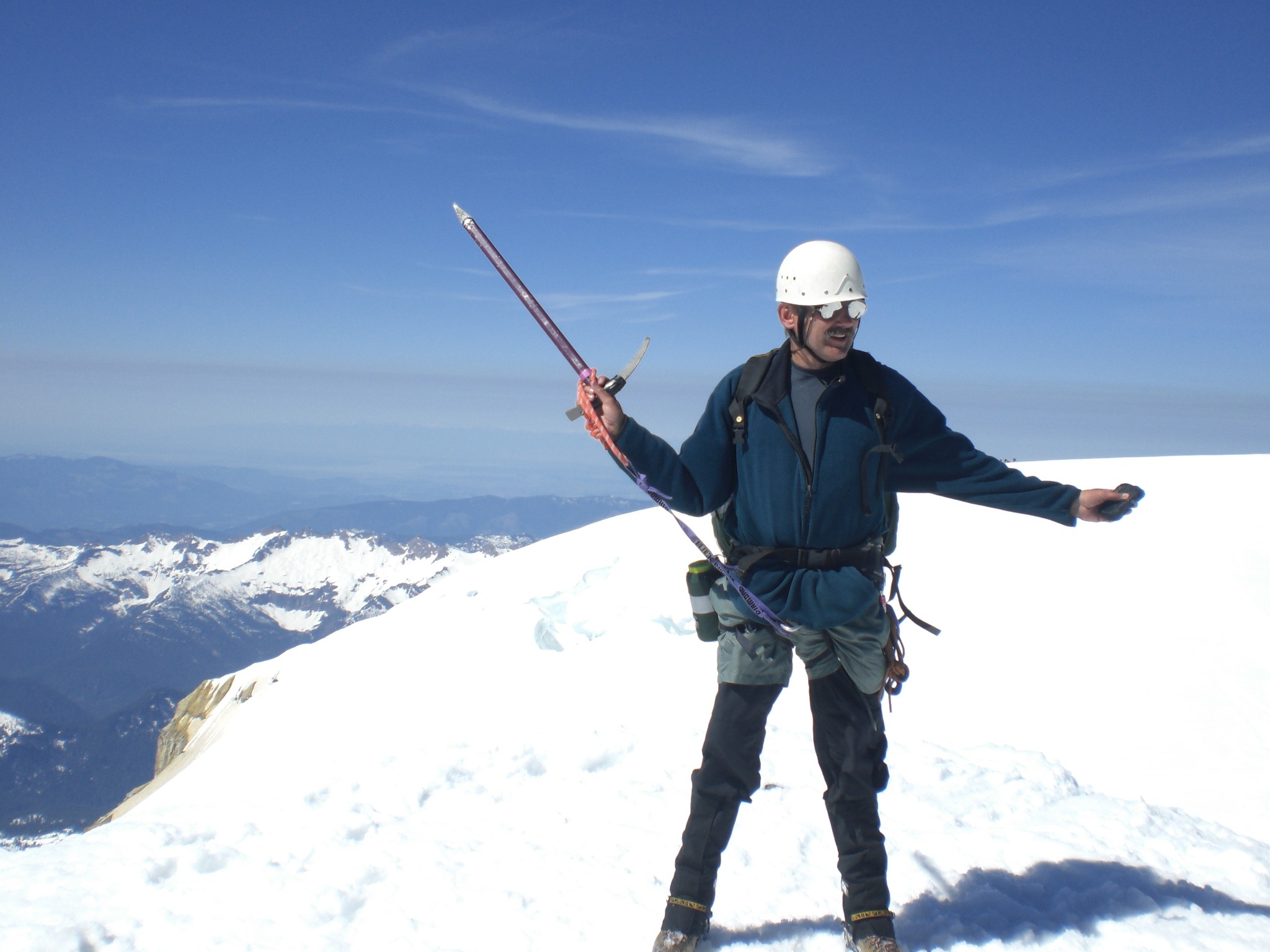 Me on top of Mount Baker (Komo Kulshan) 10,778 feet / 3,285 metres |
Unranked (less than 300 foot rise)
Some Trailheads:

Mount Evans Wilderness, Colorado

Ute Creek Trailhead, Lost Creek Wilderness
Arizona Snowbowl (for Humphreys Peak) N 35° 19.876' W 111° 42.697' 9,278 feet 2,828 metres Bartlett Trailhead, Greenhorn Wilderness, Colorado N 37° 52.703' W 104° 57.491' 8,000 feet 2,438 metres Berthoud Pass trailhead - US Highway 40
Berthoud Pass summitN 39° 47.902' W 105° 46.563' 11,307 feet 3,446 metres Borah Peak Trailhead (at the little cattle protected entrance through the wooden fence) N 44° 07.954' W 113° 50.042' 7,400 feet 2,255 metres Continental Divide Trail at Henderson Mine Road, Colorado N 39° 44.260' W 105° 51.219' 10,496 feet 3,199 metres Thomas Lakes Trail 1958, Elks Range, Colorado (for Mount Sopris) N 39° 18.236' W 107° 07.478' 8,540 feet 2,603 metres Ute Creek trailhead, Lost Creek Wilderness, Colorado N 39° 11.885' W 105° 33.212' 8,750 feet 2,667 metres
Prominence, a Definition:
In topography, "prominence" is the height of a mountain or hill's summit by the vertical distance between it and the lowest contour line encircling it and no higher summit - Prominence is a measure of the independence of a summit. Only summits with a sufficient degree of prominence are regarded as independent mountains. For example, the world's second-highest mountain is K2 (height 8,611 metres, prominence 4,017 metres). While Mount Everest's South Summit (height 8,749 metres, prominence about 10 metres) is taller than K2, it is not considered an independent mountain because it is a subsummit of the main summit (which has a height and prominence of 8,848 metres).
Yosemite Decimal System
The Yosemite Decimal System (YDS) is a three-part system used for rating the difficulty of hikes and climbs. YDS is primarily used by mountaineers in the United States and Canada. However, there are many different rating systems used around the world. Examples include the British trad grade, the French sport grade, and the International Climbing and Mountaineering Federation's (UIAA) alpine grade. As for the YDS, it was first devised by members of the Sierra Club in Southern California in the 1950s. YDS was a refinement of earlier systems, particularly those developed in Yosemite Valley.
Class 1: Hiking on a trail.
Class 2: Simple scrambling, with the possibility of occasional use of the hands. Little potential danger is encountered.
Class 3: Scrambling with increased exposure. Handholds are necessary. A rope could be carried. Falls could easily be fatal.
Class 4: Simple climbing, possibly with exposure. A rope is often used. Falls may well be fatal.
Class 5: Is considered technical roped free climbing; belaying is used for safety. Un-roped falls can result in severe injury or death. Class 5 has a range of sub-classes, ranging from 5.0 to 5.15d, to define progressively more difficult free moves.
| Classification of climbs can vary quite a bit depending on location and history. Indoor gym ratings tend to be inflated compared to outdoor ratings. Ratings tend to be lower in outdoor areas where climbing routes were developed in earlier years. Guidebooks have often raised the ratings on older climbs to make them more comparable to newer ratings. The YDS grade system also involves an optional Roman numeral grade that indicates the length and seriousness of the route. The grades are: |
|
Summit Registers
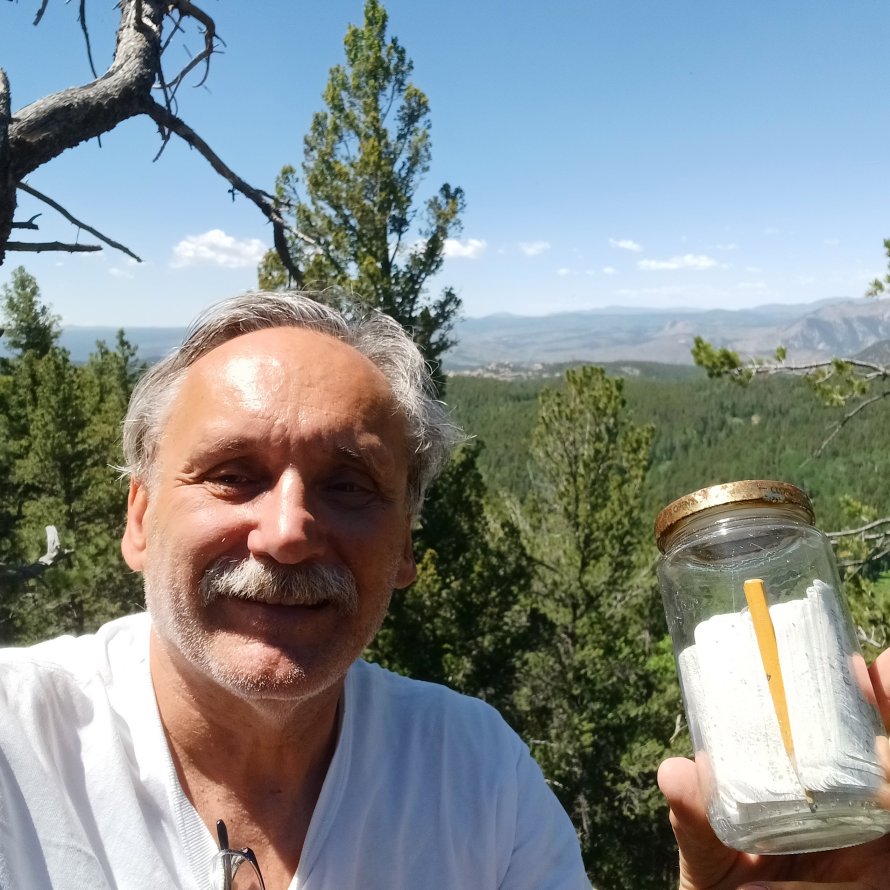
Douglas Mountain, Clear Creek County, ColoradoFor me, summit registers (held in specifically designed summit cannisters or, sometimes, in mayonnaise jars or other odd containers…) are always a fun find on the top of any peak!
However, a few years after the millennium things got a little out-of-hand and land managers (parks, BLM, forests, etc.) started discouraging their use. This was because geocaching was growing in popularity and mountain-top memorials were becoming even more popular. As such, peaks were becoming cluttered with boxes, bottles, brass plates, skis, and all sort of other junk.
In 2013 I started regular work with the Colorado Mountain Club (CMC)and had the archiving of summit registers (and the distribution of summit cannisters) as a collateral duty.
Historically, the CMC would handover any turned-in summit registers to Katie, the longtime archivist at the American Mountaineering Center in downtown Golden. Once hired by the CMC, I continued this practice but also honored the wishes of land managers by not making summit cannisters and registers available anymore.
However, “freelancers” continued creating all sorts of cannisters, for hundreds of peaks, with the completed registers ending up at the CMC office as in the past. So, to this day, although the CMC does not encourage (or supply!) summit registers they still take-in full registers for archiving.
One complication, at the time of this writing in 2026, is that the American Mountaineering Center had been sold a year earlier so, eventually, a new location for the archives (along with the mountaineering museum and library) will have to be established.
I have no idea when/where a new location for the archives will be established but it’s clear that there will continue being a lot of interest in the issue. While I was employed by the CMC it was quite common for people to request access to the archives for a variety of reasons – but the most common was probably to search old summit records for the name and date of a long-lost relative who had reached a particular peak in the past.
Whatever the reason, I hope that these old records are kept in perpetuity as they’re a very interesting part of our mountaineering history!
- Roger J. Wendell, January 2026
Links:
| Warning! Climbing, mountaineering, and backcountry skiing are dangerous and can seriously injure or kill you. By further exploring this website you acknowledge that the information presented here may be out of date or incorrect, and you agree not to hold the author responsible for any damages, injuries, or death arising from any use of this resource. Please thoroughly investigate any mountain before attempting to climb it, and do not substitute this website for experience, training, and recognizing your limitations! |
 Back to Roger J. Wendell's Home Page...

Abbey |
About |
Blog |
Contacting
Me |
Copyright |
Disclaimer |
Donate |
Guest
Book |
Home |
Links |
Site
Index |
Solutions |
Terms,
Conditions
and
Fair
Use |
What's
Changed
or
New?
Copyright
© 1955 -